
Report: Xiaomi is world’s top wearable maker for first time as Fitbit sales slide


Xiaomi’s good run has continued after a research firm found that the Chinese firm has ranked top for sales of wearable devices worldwide for the first. Sales of Fitbit devices, meanwhile, plunged by 40 percent

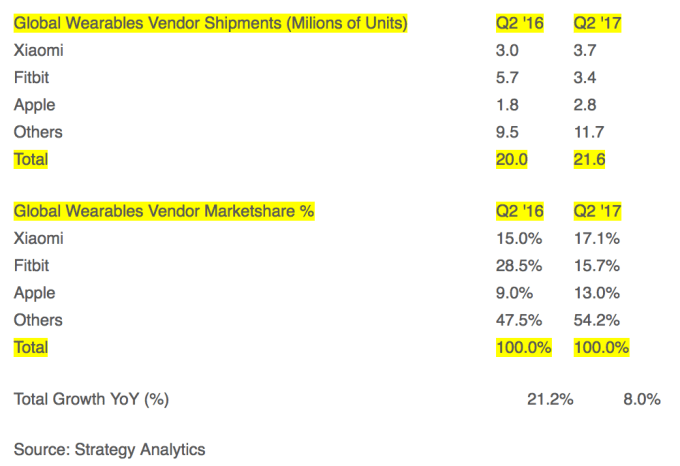
Coming off the back of Xiaomi’s reentry into the world’s top five smartphone sellers, a new Strategy Analytics report found that it leapfrogged Apple and Fitbit to become the top seller of wearables in Q2 2017 with 3.7 million units shipped. Fitbit logged 3.4 million shipments during the quarter with Apple coming in at 2.8 million — the U.S. firm actually posted higher sales growth than Xiaomi. The rest of the field was responsible for a further 11.7 million units, or 54 percent of all wearables shipped during the quarter.

Xiaomi and Apple both grew their marketshare year-on-year (from 15 percent to 17 percent, and nine percent to 13 percent, respectively), but Fitbit’s share cratered from 29 percent to 16 percent.

Both Xiaomi and Apple take very different approaches to wearables. Xiaomi has a wide range of products that are priced competitively and feature heart-rate monitors and alerts — the Mi Band is priced as low as $14.99 in the U.S. — while the Apple Watch, at upwards of $269, is a more premium approach that’s packed with a fuller set of features. While they both stand for something at different ends of the market, Fitbit’s position is less certain.

“Fitbit is at risk of being trapped in a pincer movement between the low-end fitness bands sold by Xiaomi and the fitness-led, high-end smartwatches sold by Apple,” Strategy Analytics’ Neil Mawston said in a statement.


As for the other two, Strategy Analytics said reports that the next Apple Watch may include extended health tracking capabilities could help Apple reclaim the top spot. But for now its lack of health band options is what the firm believes is keeping Xiaomi ahead, the firm concluded.

Xiaomi has had a resurgent 2017 so far, bouncing back from two disappointing years in which it struggled to maintain once-explosive growth and missed sales targets. A push into offline retail in China and progress in India, where the company cracked $1 billion in revenue last year, have contributed to a more optimistic outlook this year, with CEO Lei Jun claiming it has reached “a major inflection point in its growth.”

The company said its phone sales were up 70 percent quarter-on-quarter in Q2 with 23 million sold in Q2. Now it is pushing on with its offline retail strategy and furthering its global expansion plan thanks to a $1 billion loan that was secured last month.

More@ https://www.technapping.com

Source: Techcrunch

Comments

Popular posts from this blog

WTF is bitcoin cash and is it worth anything?

Early yesterday morning bitcoin’s blockchain forked — meaning a separate cryptocurrency was created called bitcoin cash . The way a fork works is instead of creating a totally new cryptocurrency (and blockchain) starting at block 0, a fork just creates a duplicate version that shares the same history. So all past transactions on bitcoin cash’s new blockchain are identical to bitcoin core’s blockchain, with future transactions and balances being totally independent from each other. For practical matters, all this really means is that everyone who owned bitcoin before the fork now has an identical amount of bitcoin cash that is recorded in bitcoin cash’s forked blockchain. But it’s not exactly this easy. If you control your own private keys, or hold your bitcoin in an exchange that said it would credit users’ balances with bitcoin cash, you’re fine and can access your newfound cryptocurrency right now. If you held your bitcoin with a provider like Coinbase, which said before the fork t...

Google Maps suggests BlaBlaCar for long-distance rides

Google Maps on Android and iOS now has a new transportation option. If you live in a country where French startup BlaBlaCar operates, you can now open the BlaBlaCar app and book a ride straight from Google Maps. Google isn’t adding a new tab just for BlaBlaCar. Instead, BlaBlaCar appears as a new option in the public transportation tab. For instance, if you’re looking at ways to go from Paris to Lyon, Google Maps suggests taking the TGV train — and now also BlaBlaCar. The app gives you an ETA for each transportation mode so that you can compare how long it’s going to take if you opt for the train or BlaBlaCar. Google Maps uses the same ETA for BlaBlaCar and a normal car ride. It also estimates the cost of a BlaBlaCar ride. BlaBlaCar is a ridesharing service for long-distance rides between two cities. It has tens of millions of members in dozens of countries. Think about it as a sort of Airbnb for carpooling. When you are driving from one city to another, BlaBlaCar can help you fi...

Carwow, a UK startup that helps you buy a new car, raises $39M Series C

Carwow , a platform that helps you buy a new car, has closed $39 million in Series C funding. The round was led by new investor Vitruvian Partners, with existing investors Accel Partners and Balderton Capital also participating. At today’s exchange rate it brings total funding to approximately $62.6 million. Founded in late 2010, Carwow originally launched as a car review aggregator before pivoting to become a site that claims to improve the experience of buying a new car. It allows consumers to compare offers online and buy directly from ‘trusted’ dealers that are registered with the platform, specifically avoiding the arduous but otherwise necessary requirement to haggle over price and in a way that potentially introduces more transparency. Specifically, through Carwow you can research, select and configure new cars before receiving and offers from U.K. franchised dealers. The idea is that you can then make an informed decision on those offers based on price, location, dealer rating...