
In and interview earlier this week at the TechCrunch Robotics Session held on the MIT campus in Cambridge, MA, Sami Atiya, president of ABB’s Robotics and Motion division, said he believes bringing robots into the manufacturing process actually adds jobs instead of killing them.
ABB certainly has some data points with more than 300,000 industrial robots installed worldwide, and Atiya claims that conventional wisdom is wrong when it comes to robots and jobs. “Automation is going to drive more productivity and also jobs,” he said. He went on to say that countries with the highest ratios of humans to industrial robots in production environments also have the lowest rates of manufacturing unemployment.
“If you look at pure data and statistics,” he said, “in the countries that have the highest rates of robots per employees, which is Japan and Germany, they have about 300 robots per 10,000 employees, and they have the least unemployment…in the manufacturing sector.”
He also claimed that there have been 100,000 industrial robots installed in the U.S. in the last five years, which has resulted in 270,000 additional jobs, more than two jobs for every robot. (ABB cites the International Federation of Robotics, World Bank, OECD and BLS as sources for these numbers.)
There has been, of course, a lot of speculation that as companies increase the use of robots to automate jobs, there will be corresponding job loss. In May, an article in the LA Times appeared to back up this assertion, citing a study by PwC, which claimed that 38 percent of all U.S. jobs could be lost to automation by the early 2030s. That’s a frightening prospect to many people and to policy makers who would have to deal with the fallout if that were to happen.
An article on CNN Money from last March, smack dab in the middle of the contentious presidential campaign, cited numbers from the Bureau of Labor Statistics that 5 million manufacturing jobs have been lost since 2000. While there has been much debate for the reason, the article claims robots and machines have been a big contributing factor in replacing workers. It’s worth noting that there are still more than 12 million jobs in the sector in spite of decades of steady decline.
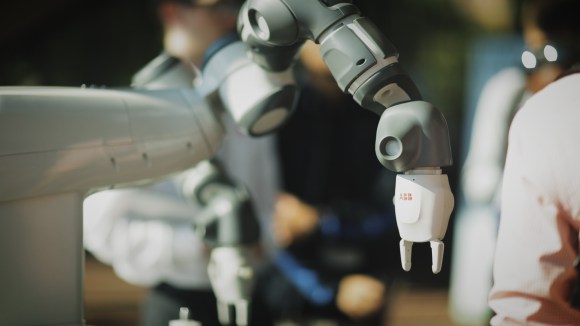
ABB Robot arm. Photo: Veanne Cao, TechCrunch
Atiya said one of the reasons companies are moving to robots is they simply can’t compete without them. “If you look at this from a macro-[economic] perspective, skilled labor is becoming [more scarce], and it’s not a question [whether] you want to do it or not. You have to do it to stay competitive as a nation, and also as a company,” he said.
Atiya used the standard argument for these types of historical economic transitions, comparing the increasing use of robotics with the rise of the steam engine, electricity and industrialization. The common belief during all of these key changes was that they would kill jobs, but in the end they created more jobs because of productivity increases, he said (and history backs him up).
“Obviously we have concerns and fears about new technologies, but ultimately we humans, I’m very convinced, will find ways to cope with them, and use them as tools as opposed to substituting our own work,” he said.
More@ https://www.technapping.com
Source: Techcrunch.com
Comments
Post a Comment