
Google Cloud gets a new networking algorithm that boosts internet throughput


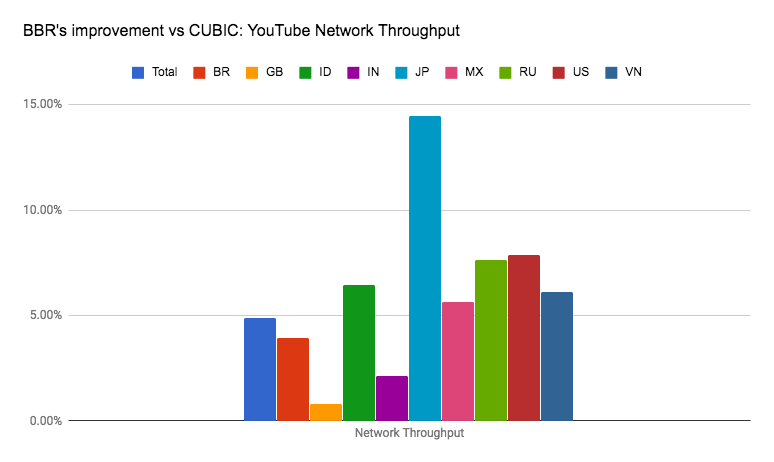
Google today announced that TCP BBR, a new congestion-control algorithm that it has used to improve network throughput from google.com and YouTube by about four percent globally (and by more than 14 percent in some countries), is now also available to its Cloud Platform users.

The general idea here is to improve on the existing congestion-control algorithms for internet traffic, which have been around since the 1980s and which typically only take packet loss into account (when networking buffers fill up, routers will discard any new packets). These algorithms decide how fast a given device should be sending data into the network to avoid overloading it. When these systems realize that some of the data packets don’t make it to their final destination, they start sending the data more slowly, which ideally reduces the amount of congestion. There are all kinds of algorithms for working out the details of how exactly to do this (and how to speed up again over time), but at their core, they all tend to follow the same patterns.


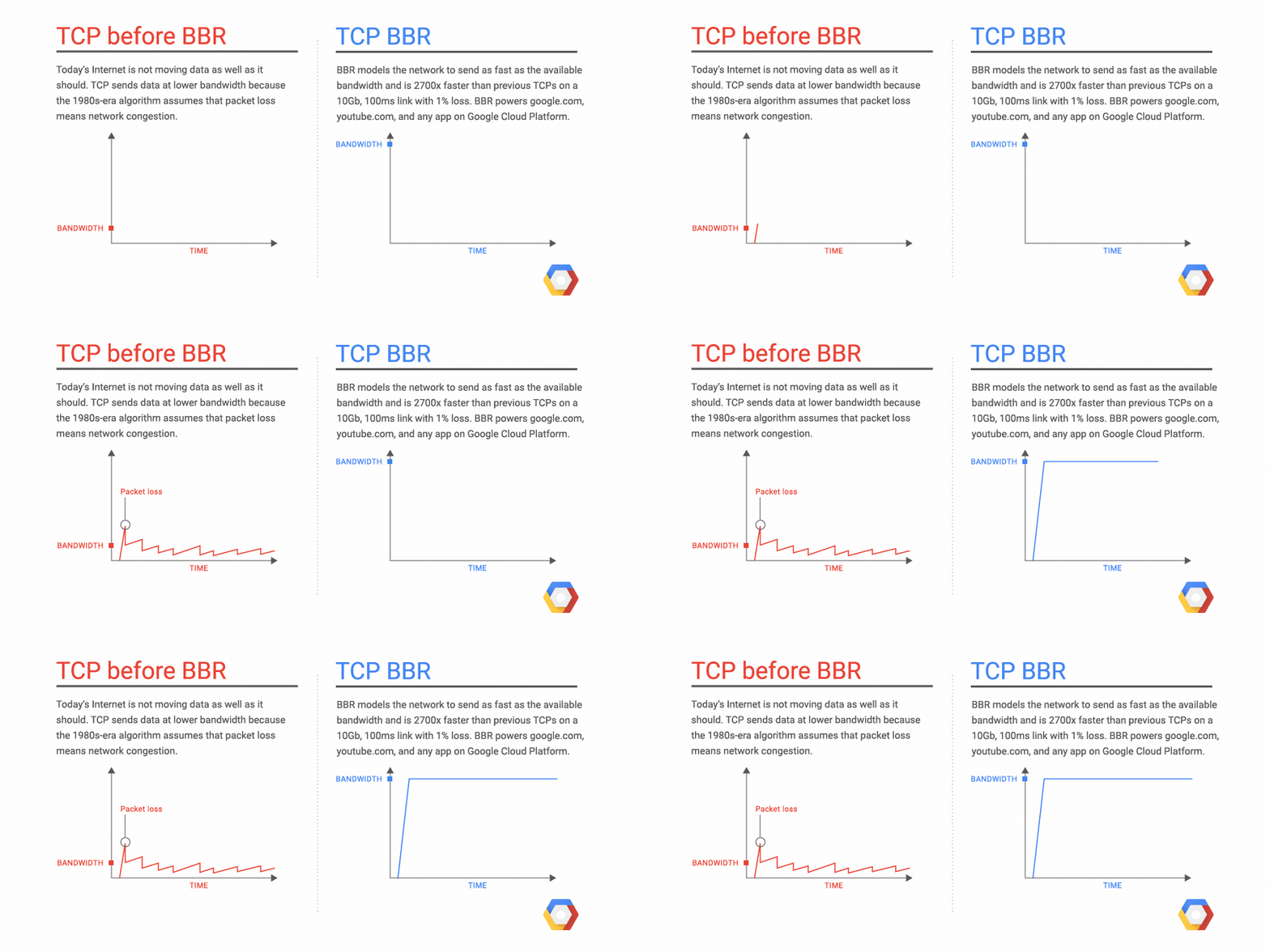
BBR, which stands for “Bottleneck Bandwidth and Round-trip propagation time,” takes a different approach. It doesn’t just look at packet loss but also at how fast the network is actually delivering data. “For a given network connection, it uses recent measurements of the network’s delivery rate and round-trip time to build an explicit model that includes both the maximum recent bandwidth available to that connection, and its minimum recent round-trip delay,” Google explains. Using this data, BBR then decides how fast it wants to send its data.


The result of this is an algorithm that can send more data at any given time (without incurring losses), especially on long-haul links. Google says one of its benchmarks showed a 2,700x increase in throughput rate, but that’s obviously an edge case and a synthetic benchmark.

The company first publicly talked about BBR in a paper last year and has since open-sourced the protocol. Google has also contributed it to the Linux kernel TCP stack.

More@ https://www.technapping.com

Source: Techcrunch.com

Comments

Popular posts from this blog

WTF is bitcoin cash and is it worth anything?

Early yesterday morning bitcoin’s blockchain forked — meaning a separate cryptocurrency was created called bitcoin cash . The way a fork works is instead of creating a totally new cryptocurrency (and blockchain) starting at block 0, a fork just creates a duplicate version that shares the same history. So all past transactions on bitcoin cash’s new blockchain are identical to bitcoin core’s blockchain, with future transactions and balances being totally independent from each other. For practical matters, all this really means is that everyone who owned bitcoin before the fork now has an identical amount of bitcoin cash that is recorded in bitcoin cash’s forked blockchain. But it’s not exactly this easy. If you control your own private keys, or hold your bitcoin in an exchange that said it would credit users’ balances with bitcoin cash, you’re fine and can access your newfound cryptocurrency right now. If you held your bitcoin with a provider like Coinbase, which said before the fork t...

Bitcoin breaks $3,000 to reach new all-time high

Bitcoin has reached a record high valuation of $3,000 per coin to complete a rollercoaster week that begin with the long-awaited split of the cryptocurrency. A number of exchanges, including popular destinations Coinbase and Kraken , valued a single bitcoin at over $3,000, an all-time high that is up $485 on the valuation one month ago. Earlier this year, Bitcoin surged to surpass $2,000 for the first time in May going on to almost reach $3,000 in June only for the valuation to crash . Over the last twelve hours, bitcoin’s value has jumped by over 10 percent as forked currency bitcoin cash has seen its valuation crash by 30 percent. Some exchanges including China’s OkCoin even put the value of one bitcoin above $3,200 right now. Finally, the surge means that the total market cap of bitcoin is more than $50 billion — $51,737,289,581 at the time of writing according to Coinmarketcap.com . A Coinbase chart shows bitcoin’s valuation has passed $3,000 per coin One chief concern around t...

Walmart expands its grocery delivery business, powered by Uber

Walmart is expanding a test of its grocery delivery service, powered by Uber, the company announced this week. The retailer is now offering grocery delivery in two new markets — Dallas and Orlando — which join Tampa and Phoenix as locations where consumers can shop online for grocery items, then opt to have them come to their home for an additional $9.95 fee. Grocery delivery has been something Walmart has experimented with for years, starting with tests in Denver and San Jose of grocery delivery using its own service and trucks. The tests involving Uber are newer, however. In June, 2016, Walmart began a trial in Phoenix, which expanded to Tampa this March. In those locations, Walmart offers grocery delivery at five local stores per market. This week’s Dallas test is larger, with 8 stores participating. In Orlando, there are four stores involved. The grocery delivery service is available via the same online grocery shopping website where customers can place their pick-up orders — a s...