
Alphabet keeps printing money despite a hefty $2.7B fine from the EU


Alphabet’s advertising business continues to grow at a mammoth pace despite a very hefty setback from the EU in the form of a massive fine — but all the signs might not be pointing to a perfect future for Google.

The EU slapped Google with a $2.7 billion fine at the end of June for antitrust violations pertaining to its Google’s Shopping search comparison service. Google baked that into its second-quarter earnings today, which still showed more than 20 percent growth in its revenue and a 52 percent jump year-over-year in the “paid clicks” — basically, Google’s eyeballs on its ads. It beat expectations across the rest of the board the rest of the way.

There is one maybe-overlooked part of Google’s report that we’ll highlight: The company’s “traffic acquisition cost,” or TAC, actually increased as a percentage of Google’s revenue year-over-year. It accounted for 21 percent of Google’s advertising revenue in the second quarter last year, and 22 percent in the second quarter this year. This may seem like a small jump, but a TAC cost that inches higher may not be a good sign and may be a negative signal to Wall Street.

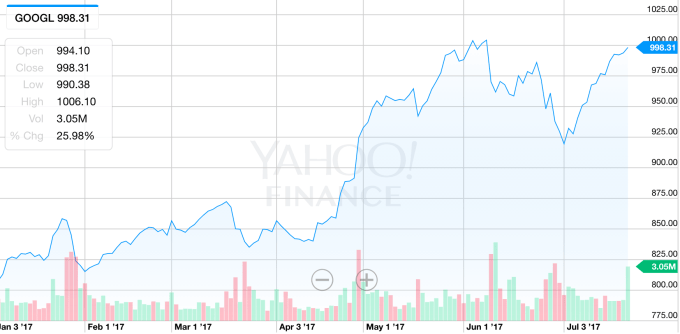
A little after the earnings report dropped, the stock fell as much as 3 percent. The company breached $1,000 per share today, but it looks like the story on this may need to play out before Google can continue its march upwards. Shares of Google are up more than 25 percent on the year despite having a somewhat rocky past month.


While that TAC jump is incremental, an increasing TAC may be a risk to Google going forward. That’s a fee that’s going to weigh on its balance sheet even as the number of eyeballs it gets on its ads continues to balloon. Google proper is still the company that will continue to drive Alphabet, even though it continues to explore new lines of businesses in its “other bets” like Nest. All this is happening while Google is tightening the belts of its extraneous projects as it looks to convert them into real businesses.

Google’s cost of revenue for the second quarter also ballooned to more than $10 billion, up from around $8.1 billion in the second quarter last year. Its revenue may have jumped 21 percent, but those costs are increasing faster than the increases in its revenue. All these are small signals, but they aren’t ones that Wall Street are going to ignore as it looks to properly price out Google’s future.

Google still wanted to bake that EU fine into its earnings to set expectations going forward. Wall Street is looking at today’s earnings report from Google through that lens, with the stock barely moving after the announcement came out. The company reported earnings of $5.01 per share on revenue of $26 billion. Analysts expected earnings of $4.46 on revenue of $20.9 billion.

More@ https://www.technapping.com

Source: Techcrunch

Comments

Popular posts from this blog

WTF is bitcoin cash and is it worth anything?

Early yesterday morning bitcoin’s blockchain forked — meaning a separate cryptocurrency was created called bitcoin cash . The way a fork works is instead of creating a totally new cryptocurrency (and blockchain) starting at block 0, a fork just creates a duplicate version that shares the same history. So all past transactions on bitcoin cash’s new blockchain are identical to bitcoin core’s blockchain, with future transactions and balances being totally independent from each other. For practical matters, all this really means is that everyone who owned bitcoin before the fork now has an identical amount of bitcoin cash that is recorded in bitcoin cash’s forked blockchain. But it’s not exactly this easy. If you control your own private keys, or hold your bitcoin in an exchange that said it would credit users’ balances with bitcoin cash, you’re fine and can access your newfound cryptocurrency right now. If you held your bitcoin with a provider like Coinbase, which said before the fork t...

Google Maps suggests BlaBlaCar for long-distance rides

Google Maps on Android and iOS now has a new transportation option. If you live in a country where French startup BlaBlaCar operates, you can now open the BlaBlaCar app and book a ride straight from Google Maps. Google isn’t adding a new tab just for BlaBlaCar. Instead, BlaBlaCar appears as a new option in the public transportation tab. For instance, if you’re looking at ways to go from Paris to Lyon, Google Maps suggests taking the TGV train — and now also BlaBlaCar. The app gives you an ETA for each transportation mode so that you can compare how long it’s going to take if you opt for the train or BlaBlaCar. Google Maps uses the same ETA for BlaBlaCar and a normal car ride. It also estimates the cost of a BlaBlaCar ride. BlaBlaCar is a ridesharing service for long-distance rides between two cities. It has tens of millions of members in dozens of countries. Think about it as a sort of Airbnb for carpooling. When you are driving from one city to another, BlaBlaCar can help you fi...

Carwow, a UK startup that helps you buy a new car, raises $39M Series C

Carwow , a platform that helps you buy a new car, has closed $39 million in Series C funding. The round was led by new investor Vitruvian Partners, with existing investors Accel Partners and Balderton Capital also participating. At today’s exchange rate it brings total funding to approximately $62.6 million. Founded in late 2010, Carwow originally launched as a car review aggregator before pivoting to become a site that claims to improve the experience of buying a new car. It allows consumers to compare offers online and buy directly from ‘trusted’ dealers that are registered with the platform, specifically avoiding the arduous but otherwise necessary requirement to haggle over price and in a way that potentially introduces more transparency. Specifically, through Carwow you can research, select and configure new cars before receiving and offers from U.K. franchised dealers. The idea is that you can then make an informed decision on those offers based on price, location, dealer rating...